Fake visa notices target Pakistani applicants in US; missions warn against unauthorised applications
WASHINGTON: The Pakistani Consulate in Los Angeles issued a stern warning against a message circulating online and on messaging platforms that claims to be an “important notice” regarding Pakistan visas.
Officials have confirmed that the message is false and is part of a pattern of phishing scams designed to collect sensitive personal and financial information from unsuspecting applicants.
Upon accessing the consulate’s website, the following notice was prominently displayed.
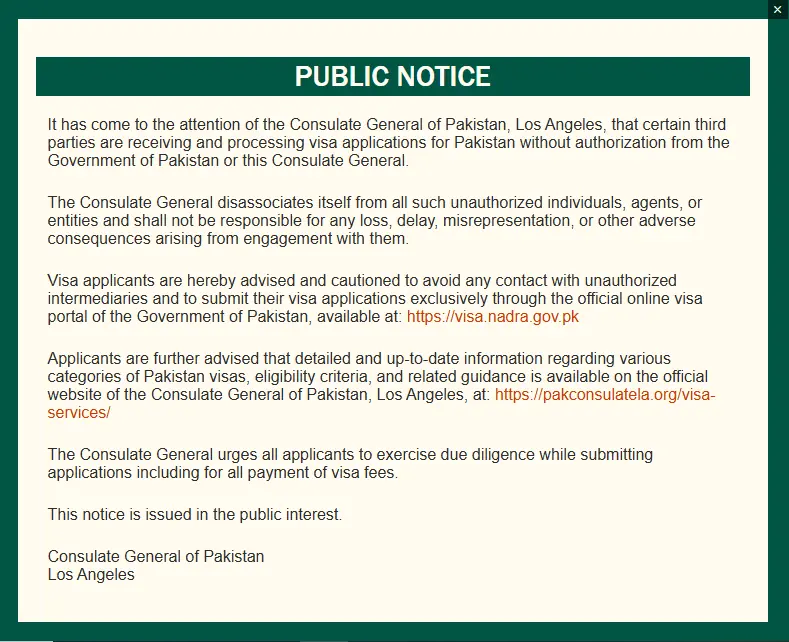
A statement issued by the Pakistan Embassy in Washington stated: “The Consulate General disassociates itself from all such unauthorised individuals, agents, or entities and shall not be responsible for any loss, delay, misrepresentation, or other adverse consequences arising from engagement with them.”
The fraudulent message falsely purports to come from the consulate and directs visa applicants to submit information through links that are not authorised by the government of Pakistan.
Such scams are designed to harvest passport details, social security numbers, bank account information, and credit card data, which can later be used for identity theft, unauthorised transactions, financial fraud and other criminal activities.
The consulate strongly reiterated that Pakistani visa applications must be submitted only through the official government online portal: https://visa.nadra.gov.pk.
Visa applicants were urged to avoid intermediaries, agents, or unauthorised websites, regardless of claims of faster processing or special access.
They were also advised to be cautious when sharing personal or financial information online, with the consulate adding that requests for social security numbers, bank details, or other identity-related data in relation to visa applications should be treated as red flags.
The public was urged by the consulate to verify all information directly through official channels and to report any suspicious messages or websites to the relevant authorities.
“This advisory is being issued in the public interest to protect applicants from scams that can have devastating financial and personal consequences,” officials said.
Applicants looking for updated guidance and official visa information were instructed to visit the consulate’s website at https://pakconsulatela.org/visa-services.
The warning comes amid a sharp rise in online fraud globally. According to the US Federal Trade Commission, consumers in the United States reported losing more than $12.5 billion to fraud in 2024, a sharp increase over previous years, as scammers increasingly exploit phishing, identity theft, and impersonation tactics online.
Data also show a significant rise in credit card fraud and identity theft, with hundreds of thousands of cases reported in 2025 alone, highlighting how criminals misuse personal and financial information once it is obtained.
Cybersecurity researchers have documented an 18 per cent increase in phishing attacks in Pakistan during 2024, as criminals increasingly target individuals with deceptive links and spoofed communication.
Courts in the United States and other countries have sentenced individuals involved in multi-million-dollar phishing and fraud schemes, where victims — often targeted through impersonation and phishing — were defrauded of large sums.
Officials noted that victims of similar scams have, in some cases, lost their entire life savings, as stolen data is used to gain access to bank accounts, obtain fraudulent loans, or conduct unauthorised transfers.
from Dawn - Home https://ift.tt/KxfLd4Y
Comments
Post a Comment